
Introduction
As enterprises grow, managing operations becomes increasingly complex. Multiple software platforms, disconnected workflows, and siloed data often create inefficiencies that slow decision-making, reduce productivity, and impact customer experiences. While organizations continue investing in digital transformation initiatives, many still struggle to connect people, processes, and technology into a unified operational framework.
Traditional workflow automation helps streamline repetitive tasks, but it often falls short when business processes span multiple departments, systems, and stakeholders. Modern enterprises need a more intelligent approach that enables seamless coordination across their entire operational ecosystem.
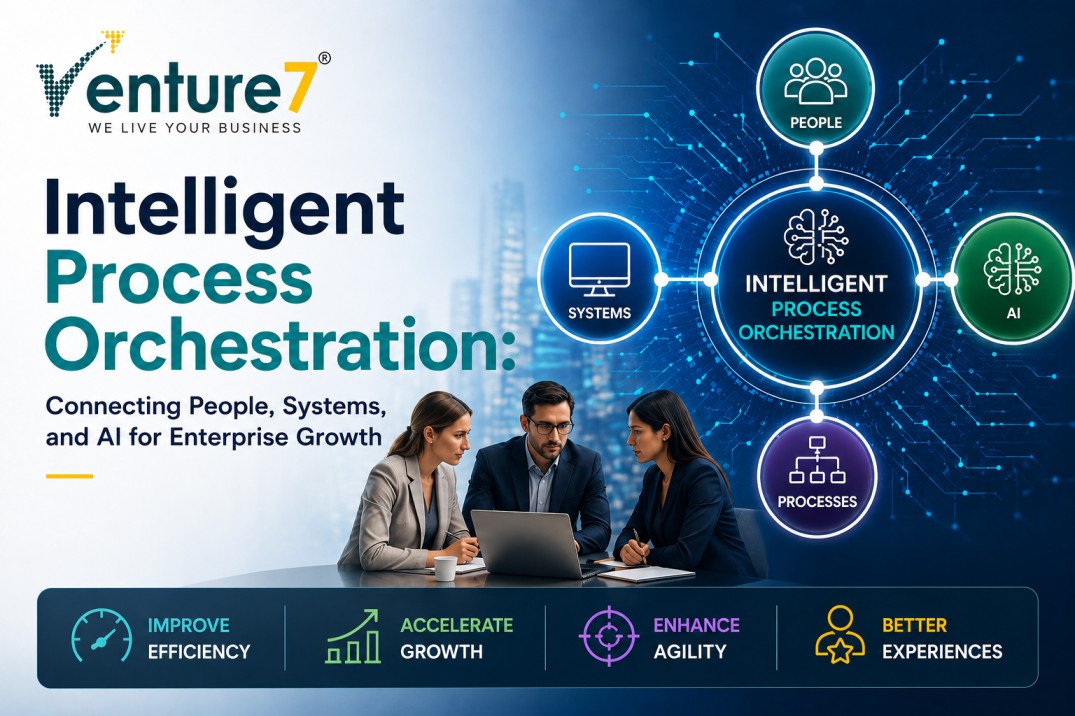
This is where Intelligent Process Orchestration (IPO) comes in. By combining workflow automation, enterprise integration, process intelligence, and artificial intelligence, Intelligent Process Orchestration connects systems, teams, and data to create efficient, end-to-end business processes. It helps organizations eliminate operational silos, improve visibility, accelerate decision-making, and scale operations more effectively.
In this article, we’ll explore what Intelligent Process Orchestration is, its core components, business benefits, real-world use cases, implementation challenges, and why it is becoming a key driver of enterprise growth and digital transformation.
Why Enterprises Need Intelligent Process Orchestration
Modern organizations rely on multiple platforms to manage business operations, including CRM systems, ERP solutions, HR software, finance applications, customer support tools, project management platforms, and supply chain systems. While these technologies support specific business functions, they often operate independently, creating fragmented workflows and limiting visibility across the organization.
As businesses scale, operational complexity increases significantly. Teams become more distributed, customer expectations continue to rise, and organizations must process larger volumes of data while maintaining efficiency and compliance. In many cases, employees spend considerable time manually transferring information between systems, following up on approvals, and coordinating activities across departments.
This fragmented approach creates several challenges:
- Data silos across departments
- Duplicate manual work
- Delayed approvals and reporting
- Limited operational visibility
- Inconsistent customer experiences
- Increased operational costs
- Reduced employee productivity
Without a connected operational framework, organizations struggle to maintain agility and scale effectively. Intelligent Process Orchestration addresses these challenges by ensuring workflows, systems, and stakeholders work together seamlessly.
What Is Intelligent Process Orchestration?
Intelligent Process Orchestration is a strategic approach that coordinates people, systems, workflows, and AI-driven technologies to automate and optimize end-to-end business processes.
Unlike traditional automation, which focuses on individual tasks, Intelligent Process Orchestration manages complete workflows across departments and applications. It acts as the operational layer that connects enterprise technologies and ensures business processes run efficiently from start to finish.
For example, when a customer places an order, multiple systems and teams may be involved, including sales, finance, inventory management, logistics, and customer support. Instead of relying on manual coordination, an orchestration platform automatically routes information, triggers actions, manages approvals, and provides visibility throughout the entire process.
By orchestrating workflows across the organization, businesses can improve collaboration, increase efficiency, and gain greater control over operations.
Core Components of Intelligent Process Orchestration
Workflow Automation
Workflow automation forms the foundation of process orchestration by eliminating repetitive manual activities and ensuring tasks are completed consistently.
Organizations frequently rely on manual processes for approvals, document handling, data entry, and communication. These activities consume valuable time and increase the risk of delays and errors. Workflow automation streamlines these activities by creating predefined digital processes that execute automatically.
Common examples include:
- Invoice approval workflows
- Employee onboarding processes
- Customer support ticket routing
- Procurement approvals
- Compliance documentation workflows
Benefits include:
- Faster process execution
- Reduced human error
- Improved compliance
- Increased productivity
- Better process consistency
Workflow automation creates the foundation upon which intelligent orchestration strategies are built.
Artificial Intelligence and Machine Learning
Artificial Intelligence (AI) and Machine Learning (ML) serve as the intelligence layer of Intelligent Process Orchestration. While workflow automation focuses on executing predefined tasks, AI enables systems to learn from data, identify patterns, predict outcomes, and support intelligent decision-making.
Modern enterprises generate vast amounts of operational data every day. AI-powered orchestration platforms analyze this data in real time to uncover insights, optimize workflows, and recommend actions that improve business performance. Instead of relying solely on static rules, these systems continuously adapt to changing business conditions, enabling organizations to become more agile, proactive, and data-driven.
By integrating AI and machine learning into business processes, organizations can improve efficiency, reduce operational risks, enhance customer experiences, and make smarter decisions at scale.
Predictive Analytics
Predictive analytics uses historical and real-time data to forecast future outcomes. Rather than reacting to events after they occur, organizations can anticipate trends, identify risks, and make proactive decisions.
For example, AI can analyze purchasing behavior to predict customer demand, helping organizations optimize inventory levels and reduce stock shortages. Similarly, predictive models can identify customers at risk of churn, enabling businesses to take preventive measures before losing revenue.
Benefits of predictive analytics include:
- Improved demand forecasting
- Better resource planning
- Reduced operational risks
- Increased revenue opportunities
- Enhanced strategic decision-making
Intelligent Task Routing
In many organizations, tasks are assigned manually, which can lead to delays, workload imbalances, and inconsistent outcomes.
AI-powered task routing automatically assigns work based on multiple factors, including employee expertise, workload availability, task complexity, service-level agreements (SLAs), and business priorities.
For example, customer service requests can be routed to the most qualified agent, while procurement approvals can be directed to the appropriate stakeholders based on predefined business rules and real-time conditions.
Benefits include:
- Faster response times
- Improved resource utilization
- Balanced workloads
- Increased productivity
- Enhanced customer satisfaction
Risk Detection and Compliance Monitoring
Organizations face numerous operational, financial, and regulatory risks. Traditional monitoring methods often identify issues only after they have already impacted business performance.
AI continuously monitors workflows, transactions, and business activities to detect unusual patterns and potential risks before they become significant problems.
Examples include:
- Fraud detection in financial transactions
- Compliance violations in regulated industries
- Security threats within enterprise systems
- Supply chain disruptions
- Process anomalies and bottlenecks
By identifying issues early, organizations can reduce risk exposure, improve compliance, and strengthen operational resilience.
Automated Recommendations
AI-driven orchestration platforms can provide actionable recommendations that help employees and decision-makers improve outcomes.
Instead of simply presenting data, AI analyzes information and suggests the most effective actions based on business objectives and historical performance.
Examples include:
- Recommending inventory replenishment levels
- Suggesting workflow optimizations
- Identifying upselling opportunities
- Prioritizing customer service requests
- Highlighting process improvement opportunities
These recommendations enable faster and more informed decision-making across the organization.
Automated Decision-Making
Advanced orchestration platforms can automate routine decisions using predefined business logic and AI models.
Examples include:
- Approving low-risk transactions
- Prioritizing service requests
- Routing customer inquiries
- Processing insurance claims
- Managing inventory replenishment
By automating routine decisions, organizations reduce manual effort while improving speed and consistency.
By combining automation with intelligence, organizations can transition from reactive operations to proactive, predictive, and highly efficient business processes.
Process Intelligence
Process intelligence provides organizations with comprehensive visibility into how workflows perform across the enterprise. It combines data collection, analytics, process monitoring, and performance measurement to help organizations understand how work flows through systems and departments.
Without process intelligence, organizations often rely on assumptions when evaluating performance. Process intelligence provides objective, real-time insights that enable leaders to identify inefficiencies, optimize workflows, and improve business outcomes.
Real-Time Process Monitoring
Modern orchestration platforms continuously monitor workflows and operational activities across the organization.
This allows businesses to track:
- Workflow completion rates
- Process cycle times
- Resource utilization
- Task completion status
- Service-level agreement performance
Real-time visibility enables teams to identify issues quickly and take corrective action before they impact operations.
Bottleneck Identification
Operational bottlenecks can significantly reduce efficiency and increase costs.
Process intelligence helps organizations identify:
- Delayed approvals
- Resource constraints
- Manual process dependencies
- Workflow interruptions
- System performance issues
Once bottlenecks are identified, organizations can implement targeted improvements that enhance process efficiency.
Performance Analytics
Organizations can measure process performance using key performance indicators (KPIs) such as:
- Process completion times
- Error rates
- Customer response times
- Employee productivity
- Cost per transaction
These insights support data-driven decision-making and continuous optimization.
Continuous Process Improvement
Process intelligence enables organizations to move beyond one-time improvements and establish a culture of continuous optimization.
By regularly analyzing workflow performance, businesses can identify emerging challenges, adapt processes, and improve operational effectiveness over time.
Enterprise Integration
Enterprise integration is one of the most critical components of Intelligent Process Orchestration because it connects the technologies that power modern business operations.
Most organizations rely on multiple applications to manage various functions. Without integration, these systems operate independently, creating information silos, duplicating work, and limiting visibility.
Enterprise integration ensures information flows seamlessly across the organization, enabling departments to collaborate more effectively and operate as a unified ecosystem.
Connecting Enterprise Systems
Integration connects business-critical applications such as:
- CRM platforms
- ERP systems
- Financial software
- Customer service applications
- HR management tools
- Procurement systems
- Third-party applications
This creates a connected environment where information is automatically shared between systems without manual intervention.
Eliminating Data Silos
Disconnected systems often create fragmented data environments that make reporting and decision-making difficult.
Integration enables organizations to:
- Create a single source of truth
- Improve data accuracy
- Reduce duplicate records
- Increase visibility across departments
This improves operational efficiency and supports better business decisions.
Improving Cross-Department Collaboration
Connected systems allow teams to access relevant information without relying on manual updates or email communication.
Benefits include:
- Faster information sharing
- Improved collaboration
- Better customer experiences
- Reduced administrative effort
- Increased organizational agility
Supporting Digital Transformation
Enterprise integration serves as the foundation for broader digital transformation initiatives by ensuring technologies work together efficiently and support end-to-end process automation.
Human-in-the-Loop Collaboration
While automation and AI continue to transform enterprise operations, human expertise remains essential. Many business decisions require contextual understanding, critical thinking, ethical judgment, and relationship management that technology cannot fully replicate.
Human-in-the-loop collaboration combines the efficiency of automation with the intelligence and oversight of human decision-makers.
Balancing Automation and Human Expertise
Intelligent Process Orchestration ensures employees remain involved in situations where human judgment is required.
Examples include:
- Contract approvals
- Compliance reviews
- Strategic planning
- Customer dispute resolution
- High-value financial transactions
This balance improves both efficiency and decision quality.
Exception Management
Not every process follows a predictable path.
When unusual situations arise, orchestration platforms automatically escalate tasks to the appropriate employees for review and action.
This ensures exceptions are handled quickly without disrupting overall workflow performance.
Improved Decision-Making
AI provides recommendations and insights, while humans evaluate context and make final decisions when necessary.
This collaborative approach combines:
- Data-driven intelligence
- Human expertise
- Strategic judgment
- Risk awareness
The result is faster, more informed, and more reliable decision-making.
Enhancing Employee Productivity
Rather than replacing employees, Intelligent Process Orchestration empowers them by eliminating repetitive administrative work and allowing them to focus on strategic, creative, and customer-focused activities.
This improves job satisfaction, increases productivity, and enables organizations to maximize the value of their workforce.
Ultimately, Human-in-the-Loop Collaboration ensures that organizations benefit from both technological efficiency and human intelligence, creating more resilient and effective business operations.
Intelligent Process Orchestration vs Traditional Workflow Automation
Many organizations assume workflow automation and process orchestration are the same. While both improve efficiency, they differ significantly in scope and capabilities.
| Traditional Workflow Automation | Intelligent Process Orchestration |
|---|---|
| Focuses on individual tasks | Coordinates complete business processes |
| Rule-based workflows | AI-powered decision support |
| Department-level automation | Enterprise-wide orchestration |
| Limited visibility | End-to-end visibility |
| Static processes | Dynamic workflows |
| Reactive operations | Predictive operations |
Workflow automation improves individual activities, while Intelligent Process Orchestration transforms how the entire enterprise operates.
How Intelligent Process Orchestration Drives Enterprise Growth
Organizations implementing Intelligent Process Orchestration often experience measurable improvements across operational, strategic, and customer-focused areas.
Improved Operational Efficiency
Connected workflows reduce delays and eliminate unnecessary manual work. Organizations can streamline processes, improve resource utilization, and reduce operational costs.
Benefits include:
- Faster process execution
- Reduced administrative effort
- Lower operating costs
- Increased productivity
- Improved process consistency
Enhanced Customer Experience
Customer expectations continue to evolve. Businesses must deliver seamless, personalized, and timely experiences across every interaction.
Intelligent Process Orchestration helps organizations:
- Respond faster to customer inquiries
- Improve service consistency
- Personalize customer interactions
- Reduce issue resolution times
- Increase customer satisfaction
Greater Organizational Agility
Organizations must adapt quickly to changing market conditions, customer demands, and emerging opportunities.
Orchestrated workflows enable businesses to:
- Launch new services faster
- Scale operations efficiently
- Respond to disruptions effectively
- Improve business resilience
Agility has become a critical competitive advantage in today’s business environment.
Better Decision-Making
Real-time visibility and AI-powered insights provide leaders with the information needed to make faster and more informed decisions.
Organizations gain access to:
- Performance dashboards
- Predictive analytics
- Operational insights
- Risk intelligence
- Business forecasts
This improves both strategic planning and day-to-day operations.
Real-World Use Cases of Intelligent Process Orchestration
Customer Onboarding
Customer onboarding often requires coordination between sales, compliance, finance, and customer success teams.
Intelligent Process Orchestration automates:
- Document collection
- Identity verification
- Compliance checks
- Account creation
- Customer communications
The result is faster onboarding and improved customer experiences.
Financial Operations
Finance teams use orchestration to streamline:
- Invoice processing
- Payment approvals
- Expense management
- Financial reporting
- Audit preparation
This reduces administrative workloads while improving accuracy and compliance.
Supply Chain Management
Supply chain operations involve multiple stakeholders, systems, and processes.
Orchestration helps organizations:
- Improve inventory visibility
- Optimize procurement workflows
- Enhance demand forecasting
- Reduce operational disruptions
- Improve delivery performance
Human Resources
HR departments leverage orchestration to automate:
- Recruitment processes
- Employee onboarding
- Performance reviews
- Learning and development programs
- Workforce planning
This improves employee experiences while increasing operational efficiency.
Customer Service Operations
Customer support teams use orchestration to route inquiries, prioritize requests, escalate issues, and provide agents with relevant information.
Benefits include:
- Faster response times
- Improved service quality
- Better customer satisfaction
- Reduced support costs
Common Challenges of Implementation
While Intelligent Process Orchestration offers significant benefits, successful implementation requires careful planning.
Legacy Systems
Many organizations rely on older technologies that were not designed for modern integration requirements.
Modernizing and connecting these systems can be challenging.
Data Quality
Poor-quality data can impact workflow performance and AI accuracy.
Organizations must establish strong data governance practices.
Change Management
Employees may resist new processes and technologies.
Successful implementation requires:
- Leadership support
- Employee training
- Clear communication
- Ongoing adoption strategies
Security and Compliance
Organizations must ensure connected systems remain secure and comply with industry regulations.
Strong governance frameworks are essential for long-term success.
Future Trends in Intelligent Process Orchestration
The future of enterprise operations will be increasingly intelligent, connected, and autonomous.
AI Agents
AI agents are emerging as digital workers capable of managing tasks, making recommendations, and coordinating workflows across systems.
Hyperautomation
Hyperautomation combines AI, robotic process automation, analytics, and orchestration to automate entire business functions.
Autonomous Operations
Organizations are moving toward self-optimizing operational environments that continuously improve performance with minimal manual intervention.
Human-AI Collaboration
Future enterprises will combine AI-driven efficiency with human creativity and strategic thinking to create more productive workplaces.
These innovations will continue to shape the future of enterprise operations.
How Venture7® Helps Organizations Build Intelligent Operations
Implementing Intelligent Process Orchestration requires the right combination of strategy, technology, and execution expertise.
Venture7® helps organizations design, implement, and scale orchestration solutions that connect people, systems, and AI.
Our services include:
- Workflow automation
- Enterprise integration
- AI implementation
- Process optimization
- Digital transformation consulting
- Operational modernization
By creating connected and intelligent operational ecosystems, Venture7® helps enterprises improve efficiency, increase agility, and accelerate growth.
Conclusion
As enterprises continue to embrace digital transformation, operational complexity will only increase. Disconnected systems, fragmented workflows, and manual processes create inefficiencies that limit productivity, slow decision-making, and impact customer experiences.
Intelligent Process Orchestration provides a powerful solution by connecting people, systems, workflows, and artificial intelligence within a unified operational framework. It enables organizations to streamline operations, improve visibility, enhance agility, and scale more effectively.
Businesses that successfully implement Intelligent Process Orchestration will be better positioned to drive innovation, improve operational performance, and create sustainable competitive advantages in an increasingly digital economy.
Ready to Transform Enterprise Operations?
Partner with Venture7® to unlock the full potential of Intelligent Process Orchestration. Our experts can help you connect systems, automate workflows, integrate AI, and build future-ready operations that support long-term business growth.